
Put on "Umbrella," then "HUMBLE.," then a Bruno Mars ballad, back to back. Different worlds — but they all do the same thing to your chest: they make you feel something before you've had a chance to notice how loud, how wide, or how expensive they are. That's Manny Marroquin. The records are big and polished, yet somehow you can hit repeat all day without the ear fatigue that kills most modern mixes.
The short version: Marroquin mixes for emotion first and treats every technical choice — vocal loudness, effects, EQ, even the low end — as a storytelling decision rather than a default. That's why his mixes feel guided instead of assembled.
The feeling: push, pull, breathe
The defining quality of a Marroquin mix isn't brightness or width. It's motion. He lets an element bloom, then reels it back, so the record breathes and builds even when it's slammed loud. A verse pulls in on itself so the chorus can open up. Nothing sits static.
Two things make that contour work, and both are quietly radical:
- He shapes the build with frequency, not just volume — filtering elements in and out so a section feels bigger without the meter moving.
- His effects create depth, not echo. Reverbs and delays are usually tucked so far back you feel the space rather than hear the effect.
And the vocal is never on autopilot. Sometimes it's forward and aggressive; sometimes it's nestled deeper into the track. Where it sits is a story call, not a habit.
How he actually works
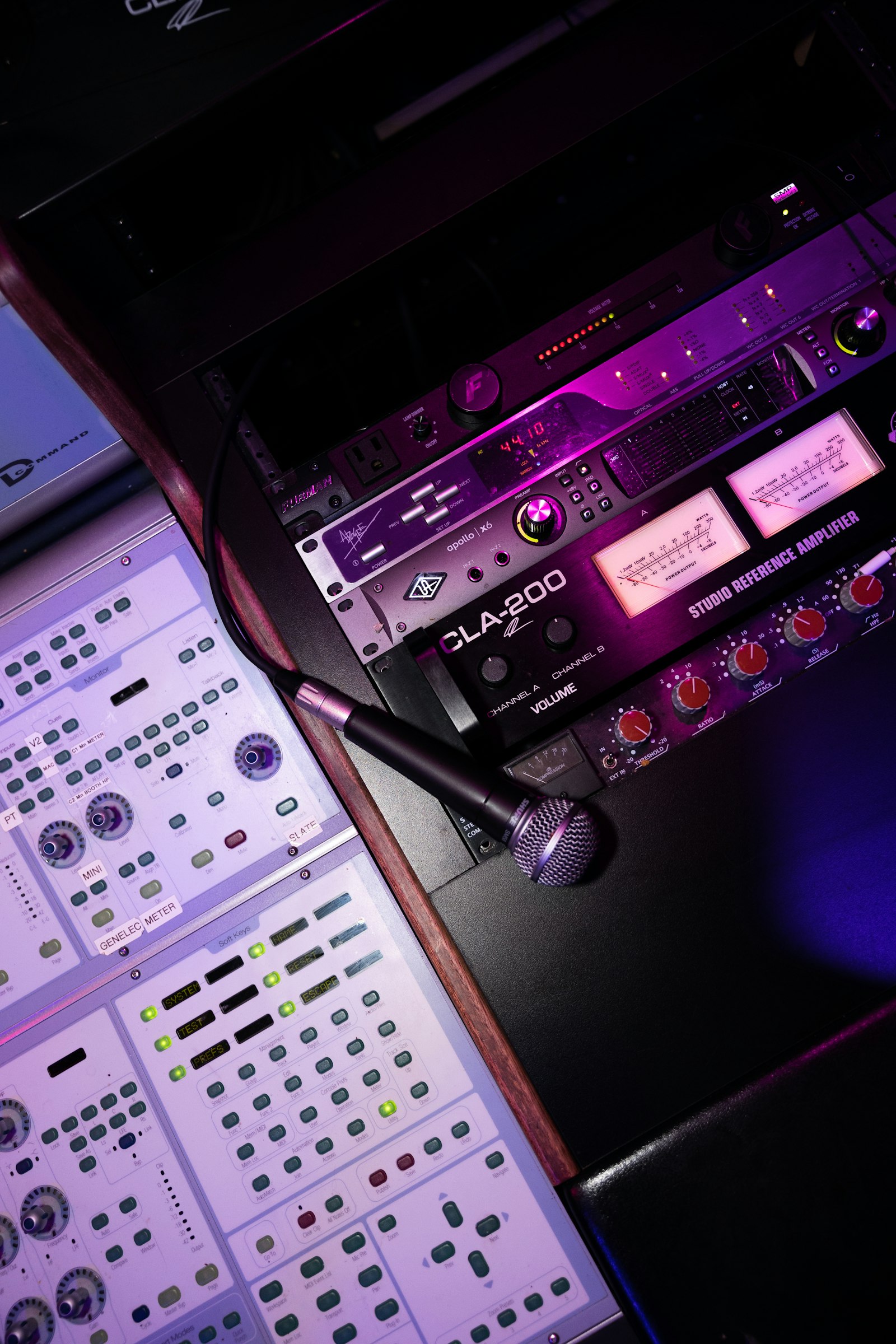
Marroquin has spent his career at Larrabee Studios in Los Angeles, working on an SSL 9000 K-series console, and he's refreshingly unromantic about gear. Plugin versus hardware is just a different color to reach for depending on the moment — whichever has the character the section needs. He also performs the mix — hands on the faders, working intuitively rather than staring at a screen and chasing numbers.
The build order is emotion-first and disciplined:
- Start with all faders at zero and come up from silence.
- Build drums and rhythm first, referencing the vocal every 20–30 minutes so the groove is always serving the singer.
- Fill in the rest of the arrangement, bringing vocals in once the track underneath is solid.
- Work heavily in stereo submixes and stems for instant recall, organizing Pro Tools like a tape machine — drums and rhythm section on one side, vocals on the other, everything else filling the gaps.

His processing philosophy is where the transferable gold lives. He reaches for EQ before compression, and he thinks about what's around the sound — clearing space for an element instead of only hammering the element itself. On low end he preaches restraint: "less is more... nine out of ten times you're screwing it up by doing something to it. Just let it breathe."
Even his signatures are emotional tools. His de-essing runs through an SSL side-chain — a narrow boost at the sibilant frequency drives a frequency-specific compressor, so the harshness comes down without dulling the whole top end or flattening the singer's personality. And the famous "throws": he treats delay and reverb as depth rather than decoration, often layering effects on a single send — a slap delay into a reverb, sometimes with distortion or a phaser stacked in. That instinct is literally why his Waves signature plugins each bundle several processors into one box — the delay plugin alone combines reverb, distortion, a doubler, and a phaser, because that's the chain he reaches for anyway.
Underneath all of it is one repeated idea: "at the end of the day, music is about an emotion. That's all. We're selling an emotion." His self-test isn't a spectrum analyzer. It's a question: how do you feel after you turn the volume up? If the record still feels good loud, the technical choices did their job. If it feels tiring, something was decided for the meter instead of the listener.
What you can steal
You don't need Larrabee or an SSL to work this way. You need the priorities.
- Mix for a feeling, then gut-check by turning it up. Decide what the song should make you feel, do a pass, and ask what you actually feel when it's loud. If the answer is "tired," you've overcooked it.
- Build push-pull on purpose. Pull elements back in the verse so the chorus genuinely lifts. Use filtering, not just volume, to make a section feel bigger — high-passing supporting parts in the verse and opening them up in the chorus does more than a fader move.
- Treat vocal loudness as a story decision. Forward and in-your-face is one emotion; nestled into the track is another. Pick per song.
- Use throws for depth, not decoration. A slap delay plus a touch of reverb, tucked far back, buys you space instead of a noticeable "effect." When you find a throw you love, commit to it — it's part of the production now.
- EQ before you compress. Carve space around a sound before you squeeze it.
- Leave a working low end alone. If the bottom already sounds good, resist the urge to "fix" it.
- Fight harshness while keeping brightness. Handle boxy, harsh, and sibilant as three separate problems instead of just pulling down the top.
- Reference on cheap consumer speakers, not only your good monitors — the emotion has to survive a phone and a laptop.
The myth worth killing
There's a widespread belief that "the Manny Marroquin sound" means big, bright, reverb-drenched vocals on everything — that if you could just get his exact settings, you'd have the sauce.
His real signature isn't a vocal template. On Kendrick Lamar's Mr. Morale & the Big Steppers, he deliberately abandoned the hyped, bright, reverberant treatment and went dry and restrained, because that's what the song needed. Marroquin has described that album's vocal sound as understated on purpose — not hyped, not pushed bright — because the emotion of the record called for something quieter and closer.
That's the through-line from Rihanna to Bruno Mars to Kendrick: not a preset, but the song dictating the decision. A pop chorus built to fill arenas and a hip-hop verse built to sit close to the listener's ear are both "the Manny Marroquin sound," even though almost nothing about their settings would transfer between them. It also explains why chasing "exact Manny settings" is a dead end — those numbers are song-specific, and his throws are so often buried that you're chasing something meant to be felt, not heard. Copy the settings and you copy a decision that was made for a different record, on a different day, for a different emotion.
The closing thought
The lesson underneath the SSL side-chains and the stacked sends is almost embarrassingly simple: the technical work exists to serve a feeling, and the moment it stops serving that feeling, it's wrong, no matter how "correct" the meter looks. Marroquin's genius isn't that he found the loudest, widest, brightest version of every song. It's that he's willing to make a vocal dry, a low end plain, or a chorus quieter than you'd expect, because that's what the emotion asked for. Ask his question after every pass — how do I feel now? — and you're already mixing more like him than any recalled preset ever could.